Book Review — Mountains Before Mountaineering and Other Everests
By: Katie Ives | A version of this review previously appeared in the 2025 American Alpine Journal.
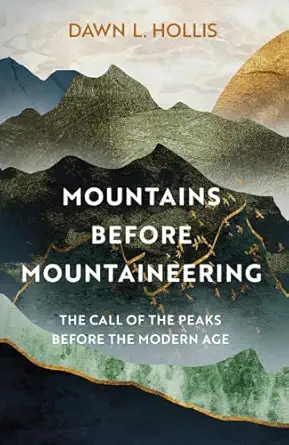
Ghosts haunt the pages of mountaineering history: names of the innumerable dead recounted in litanies of loss; blank spaces between the lines, recalling those forgotten, silenced, or erased. And there are also what historian Daniel Lord Smail refers to as "'ghost theories,' old ideas that continue to structure our thinking without our being fully aware of their controlling presence." In Mountains before Mountaineering: The Call of the Peaks before the Modern Age, Dawn Hollis describes how Smail's concept applies to her research on early European climbing history, "It seems to capture exactly what I keep coming up against: an idea so old and so oft-repeated that it has taken on the status of fact, its real origins long forgotten."
For Hollis, that mistaken "fact" is the myth that almost no one perceived the beauty of the Alps, let alone enjoyed climbing them, until the arrival of the Romantics and British mountain tourists. Her book — along with Other Everests: One Mountain, Many Worlds, edited by Paul Gilchrist, Peter Hansen, and Jonathan Westaway — is part of a growing effort to uncover errors in past histories and to reveal how these distorted narratives impact views of mountaineering today. Read together, the books trace the arc of a particular delusory vision that began in the Alps and spread across the mountain world.
For decades, best-selling authors and respected scholars have quoted seventeenth-century European descriptions of the Alps as "boils" and "warts," evoking images of perplexing ugliness and fear. "This is a compelling vision," Hollis acknowledges in Mountains before Mountaineering. "It is fascinatingly strange to imagine a time when the overall view of mountains was so at odds with that of today, and deliciously tempting to cast ourselves as having a special relationship with mountains, unknown by our ancestors…. It is also…wrong."
As Hollis deftly proves, the myth leaves out accounts of pre-eighteenth-century alpine adventurers longing to prove themselves or to encounter marvels, naturalists delighting in mountain wildflowers, religious seekers hoping to get closer to the heavens, and scholars insisting that peaks were God's ornaments on Earth. Most of all, the myth neglects the experiences of people who lived among the Alps: guides who led travelers over snowy passes, hunters who chased chamois from ledge to ledge, and herders — mostly women — who led cattle to high pastures. It was local people, Hollis shows, who started to develop many fundamental practices of mountaineering, from early crampon use to glacier travel and crevasse rescue.
For a long time, mountaineer meant someone who dwelled in the mountains.
As Victorian climbers adapted its significance to describe only their identity, they emphasized their status as heroes of mountain tales above the "porters" and "guides" who enabled their ascents, as well as other villagers who'd explored the heights before them. By claiming to have invented mountain climbing, the Victorians propagated additional myths that haunt us: a belief that a love of peaks can be cultivated best by "modern" elites, rather than shared by people from all backgrounds; an assertion that outsiders can know mountains better than local residents might; and an insistence that a "true mountaineer" climbs for "purely" recreational motives, discounting the rich variety of reasons that people have climbed and continue to do so today.
One ghost theory thus propagated others that spread beyond the Alps, restricting ideas about what kinds of protagonists count as "real" climbers and whose mountain stories matter.
Editors Paul Gilchrist, Peter Hansen, and Jonathan Westaway likewise begin Other Everests with images of ghosts, evoking the invisible creators of footprints just below the summit of Everest. Since the early twentieth century, as they note, many casual readers of classic Western mountaineering tales might have assumed such tracks usually belonged to white men on their way to complete a grandiose, heroic ascent. Yet in the sixteen essays of this volume, some of the best international mountaineering scholars demonstrate that the phantoms of the world's highest peak aren't always the ones we're conditioned to expect.
Sifting through archives and oral histories, Other Everests writers uncover figures frequently absent from dominant accounts, as if buried under windswept drifts of snow. The "fleeting detail" of a monk folding a white khata in John Noel's 1924 Everest film hints at the missing scene of the avalanche deaths of seven local staff. Images of female expedition workers and mountaineers reemerge from lesser-heard stories and old photos — such as the faded picture of a Sherpa woman bent under one of the heavy loads of the 1953 Everest expedition.
Turning to the present day, contributors describe how Sherpa outfitters, guides, and mountaineers have started to reclaim Everest as a "Nepali mountain," while inequalities persist. Through access to social media and modern communications technologies, Sherpas have found wider audiences for counternarratives that disrupt stereotypical tales and restore their own voices. And as scholar Ruth Gamble recounts, the vision of Chomolungma/Chomolangma (the mountain's Sherpa/Tibetan name) as a sacred summit has persisted — beneath the widespread image of a commodified "Mt. Everest."
The collection of essays evokes, as the editors hope, "a plurality of perspectives, a world of multiple or alternative" peaks — an abundance of once seemingly invisible mountains crystallizing into overlapping, radiant forms. As climate change accelerates, a new kind of disappearance threatens the topographies of all these "Other Everests." Countless writers in the past have described high peaks as "sublime." Today, contributor Yvonne Reddick observes, the snows of the South Col are sublimating, vanishing into the warm, thin air.
When I first heard Hollis present her research at the 2015 Thinking Mountains conference, historian Maurice Isserman congratulated her, "Now, we need to rewrite all our books." A decade later, Mountains before Mountaineering and Other Everests have joined a swell of books creating new bodies of mountain literature beyond the limits of the old canon.
In recent years, the late John Middendorf's writings have showcased the groundbreaking, often-ignored roles that women played in early big-wall ascents. Award-winning histories by Bernadette McDonald, Nandini Purandare, and Deepa Balsavar have helped restore stories of Pakistani and Sherpa expedition staff. Collections such as Danielle Williams' book Melanin Base Camp and Denisa Krásná and Alena Rainsberry's Flow: Women’s Counternarratives from Rivers, Rock, and Sky have amplified long-marginalized voices. Genre-pushing works such as Elizabeth Bradfield, CMarie Fuhrman, and Derek Sheffield’s Cascadia Field Guide have elevated plants and animals, "Beings" of the more-than-human world, as worthy heroes of alpine tales.
Back in 2015, I asked the anthropologist Pasang Yangjee Sherpa how she thought mountaineering literature should evolve. Her response, quoted again in Other Everests, now resonates even more deeply: "The story should be about the existence of multiple stories and about bringing them to light.... It should involve shifting our focus from one-way-of-being to recognizing the multiple-ways-of-being." Amid rising ecological disasters, both books suggest, we need to break free of the “ghost theories” that merely promoted accounts of summit conquests by a privileged few — and to expand the boundaries of our empathy until we recognize the stories of all people and all living things in the mountains, including the land itself. As a Ladakhi woman, Dolma, told anthropologist Karine Gagné (cited in Other Everests): "To care for the glacier, you have to see the glacier, you have to know the glacier, like you know a friend."